
What Ayres Sensory Integration® actually is.
A clinical framework, a diagnostic process, and a specific intervention method — not a category of activities.
Many people use the word "sensory." Almost everyone has heard about sensory needs, sensory diets, sensory rooms. The word has gotten loose.
Ayres Sensory Integration is something different. It is a clinical framework — a theory of how the nervous system organizes itself, a diagnostic process, and a specific intervention method — developed by Dr. A. Jean Ayres in the 1960s and built on by fifty years of peer-reviewed research.
It is practiced only by occupational therapists with advanced post-graduate certification.
“This is what we practice. This is what we mean when we say "sensory.”
THE SCIENCE
The nervous system has a developmental hierarchy.
A developmental map of how the nervous system builds the foundation for everything else — from sensory systems all the way up to academic learning.
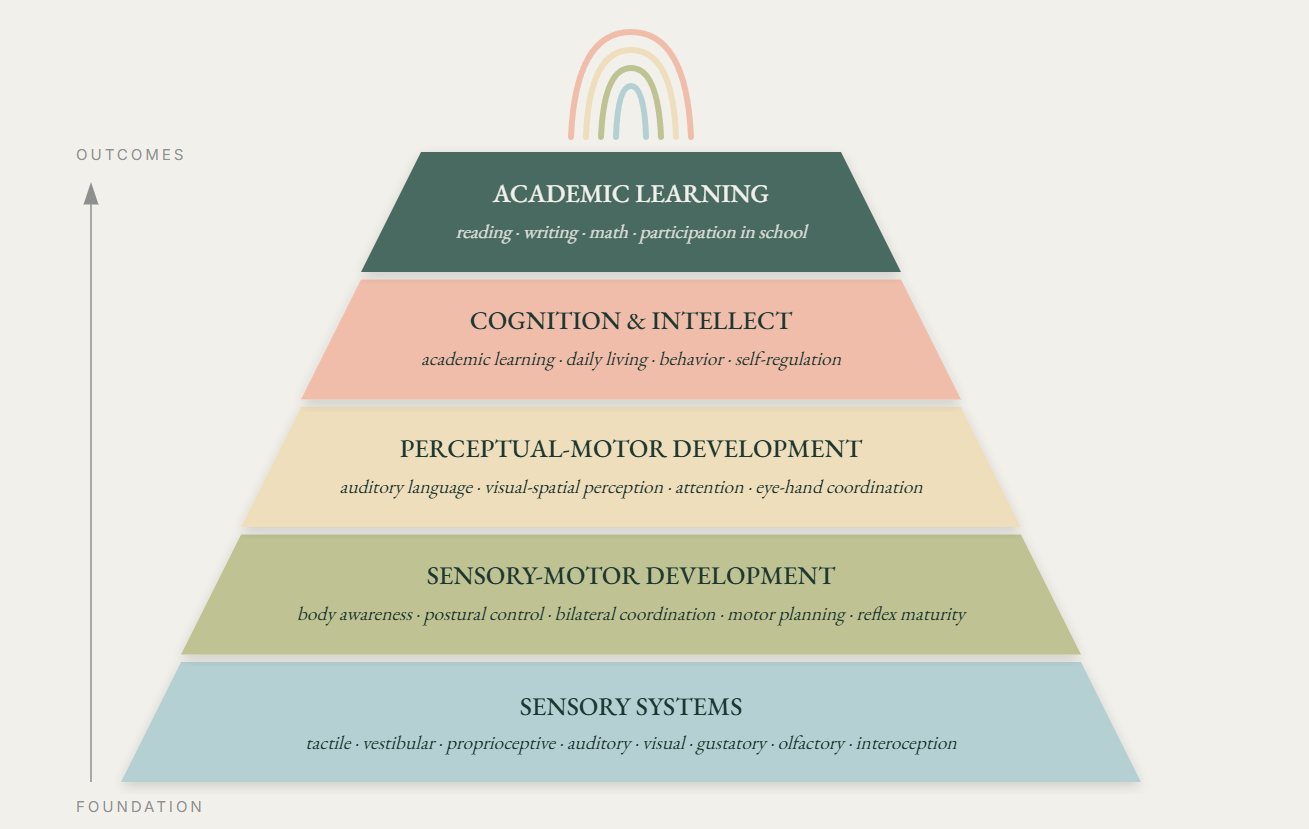
WILLIAMS & SHELLENBERGER, 1996 DR. A. JEAN AYRES
Each tier rests on the one below it. When the foundation is strong, the layers above sit stably. When the foundation is unsteady, everything above wobbles — including the academic learning at the top.
FOR USE IN PARENT EDUCATION AND CLINICAL TEACHING
Lower-order sensory systems form the foundation: the vestibular system (movement and gravity), the proprioceptive system (where the body is in space), and the tactile system (touch).
When those foundations are well-organized, higher-order capacities sit stably on top — posture, motor planning, attention, emotional regulation, social engagement, learning.
When the foundation isn't organized, everything above it wobbles. The behavior we see — the meltdowns, the avoidance, the rigidity, the exhaustion, the trouble with sleep or focus or transitions — is rarely the root cause. It's downstream of how well the nervous system can process and integrate the sensory information coming in from the body and the world.
Ayres Sensory Integration® is root-cause work. We don't intervene on the surface behavior. We assess the foundation and rebuild the system from the ground up.
— 01ASSESSMENT
What real ASI evaluation looks like.
A real Ayres Sensory Integration® evaluation isn't a parent questionnaire or a checklist.
It's a multi-hour clinical reasoning process that includes manualized standardized testing (the SIPT or EASI® assessments), a detailed sensory history, clinical observations of postural and ocular function, praxis testing (the ability to plan and execute movement), and a structured analysis of how the nervous system is — or isn't — organizing sensory information.
The result is a clinical hypothesis: which sensory systems are dysregulated, how that's showing up in this person's life, and what intervention would address it. It's the difference between "your child has sensory needs" and a precise map of what's actually happening underneath.
— 02 INTERVENTION
The adaptive response.
Ayres Sensory Integration intervention happens in a specifically equipped clinical environment — suspended equipment, controlled sensory inputs, the ability to grade and adjust in real time. These environments are engineered to fidelity and constantly changing.
The therapist follows the person's intrinsic drive while presenting a challenge slightly beyond what the nervous system can currently do. When the person meets that challenge — when they figure out how to organize themselves to do something they couldn't do a moment ago — that's an adaptive response. The nervous system, in real time, reorganizes itself to meet the demand. New neural pathways form. The system learns it is capable of more than it was.
Adaptive responses are the engine of change in ASI. They cannot be drilled. They cannot be coached from the outside. They happen only when the person is internally driven, the challenge is precisely scaled, and the environment is set up to make the right response possible.
ASI looks like play and works like rehabilitation. The play is the access point. The adaptive response is the work
Real change doesn't come from worksheets. It doesn't come from sensory diets handed out at intake. It doesn't come from activities the child is told to do. It comes from real, embodied, self-directed experience inside a precisely scaffolded environment — where adaptive responses can emerge and accumulate, session after session.
This is why ASI requires advanced training. Recognizing when the system is ready for a bigger demand, reading nervous-system cues in real time, presenting a challenge graded to within a hair's breadth of current capacity — none of it is replicable from a manual.
HOW TO KNOW WHAT YOUR GETTING
Not every "sensory" is the same.
Ayres Sensory Integration is practiced only by occupational therapists with advanced post-graduate certification (EASI, USC certification, or equivalent). Not every OT is ASI-trained. Most aren't. And no one who isn't an OT can practice it.
If you're not sure whether a provider is offering real ASI work, here are five questions that sort the field:
Five questions to ask any sensory provider
01 Are you an occupational therapist?
02 What is your post-graduate ASI certification?
03 Do you perform standardized sensory integration assessments- the SIPT or EASI ?
04 Is your clinical space equipped with suspended equipment and graded sensory input?
05 Can you explain which sensory system you’re addressing and why, and what will the adaptive response look like?
Any provider doing real ASI work will be able to answer all five clearly and without defensiveness.
NEXT STEPS
Wondering if ASI is the right fit?
We offer consultations for families, teens, and adults who want to understand whether Ayres Sensory Integration is the right starting place. We'll walk you through what to expect and answer your questions — including the five above.