
At Optimal Therapy Works (OT Works), everyone is the lead in their own story.
We offer individual and group occupational therapy services grounded in Ayres Sensory Integration and child-led play-based practice.
Through play, movement, and guided sensory experiences, we support children, adolescents, and adults in organizing sensory information, strengthening motor skills, and building confidence in everyday life. Our approach honors each person’s unique interest and needs while fostering regulation, agency, and meaningful participation.
We celebrate neurodiversity, value strengths, and partner with individuals and families to support growth that is functional, lasting, and personally meaningful.
-
Therapy and evaluations to support individual growth, regulation, and participation.
Individual Therapy
Personalized sessions for children, teens, or adults addressing sensory, motor, emotional, and functional needs.
Pediatric Therapy
Play-based OT and sensory integration support to help children regulate, learn, and thrive in daily life.
Adult Therapy – Specializing in Late-Diagnosed Women
Targeted support for adults navigating sensory, emotional, and executive challenges after a late neurodiverse diagnosis.
Group Therapy
Structured sessions where participants practice social, motor, and regulation skills together in a supportive environment.
Peer Treatment Groups
Opportunities for children or adults to build social skills, practice adaptive responses, and gain confidence through peer interaction.
Individual Education Evaluations
Comprehensive assessments of learning, sensory, and functional needs to guide personalized educational planning and accommodations.
-
Comprehensive, evidence-based assessments to guide therapy, education, and accommodations.
Why We Evaluate
Evaluations are designed to:
Initiate individualized therapy programs
Support Individualized Education Evaluations (IEEs)
Guide school accommodations and professional recommendations
Inform clinical, functional, and sensory goals
What We Assess
Our OT team provides evidence-based occupational therapy and sensory integration evaluations, including:
Sensory modulation, discrimination, and motor planning
Functional participation and adaptive responses
Emotional regulation and developmental skills
School performance, daily routines, and occupational engagement
Evaluation Process
Standard Evaluations: Typically completed in 2 sessions
Comprehensive Assessments / IEEs: May take 3–5 sessions depending on complexity
Assessments include observation, standardized tools, parent/caregiver interviews, and functional testing
Results are summarized in a comprehensive report with recommendations for therapy, school supports, and accommodations
How It Supports You
Provides a clear roadmap for therapy and skill development
Offers objective data for school teams, IEPs, or accommodations
Helps families understand strengths, challenges, and next steps
Guides professionals with actionable recommendations based on current evidence
-
esources, mentoring, and education for families, schools, and professionals.
Parent Support Groups
Safe spaces for caregivers to share strategies, gain guidance, and connect with other families navigating neurodiversity.
Community Education
Workshops, webinars, and events designed to increase understanding of sensory integration, neurodiversity, and inclusive practices.
Professional Mentorship
Clinical guidance and mentoring for OTs, therapists, and educators on evidence-based sensory integration and neurodiverse-support practices.
Space Design Consultations
Tailored recommendations for homes, schools, and therapy spaces to create sensory-friendly, developmentally supportive environments.
How can Occupational Therapy that focuses on Sensory Integration Help?
Many families are told their child has “sensory needs,” but it’s not always clear who to see or what kind of support will help. Occupational therapy with advanced training in Ayres Sensory Integration is designed to help children participate fully in the activities that matter mostat home, at school, and in play


Occupational therapy focuses on the foundation of daily life:
Helping children regulate their emotions and bodies
Supporting attention, focus, and coordination
Building routines, habits, and coping skills
Improving participation in play, learning, and self-care
OT looks at how a child’s nervous system works, not just how they behave. When the body and brain are better connected, children can respond to challenges more flexibly, instead of feeling overwhelmed or “stuck.”
Why choose an OT with advanced training in Ayers Sensory Integration ?
Ayres Sensory Integration is a specialized, play-based child led form of OT that helps the brain organize and make meaning of sensory information from the body, like movement, touch, and balance.
This connection between brain and body allows children to:
Embody regulation – learn to use their bodies to stay calm, focused, and controlled
Develop organized motor patterns – move more efficiently and confidently
Strengthen participation skills – engage in meaningful activities with less frustration
Think of it as building a stronger internal “operating system”. When the nervous system is more organized, children are able to handle challenges in daily life instead of relying solely on external cues or reminders.
The Occupation of a Child
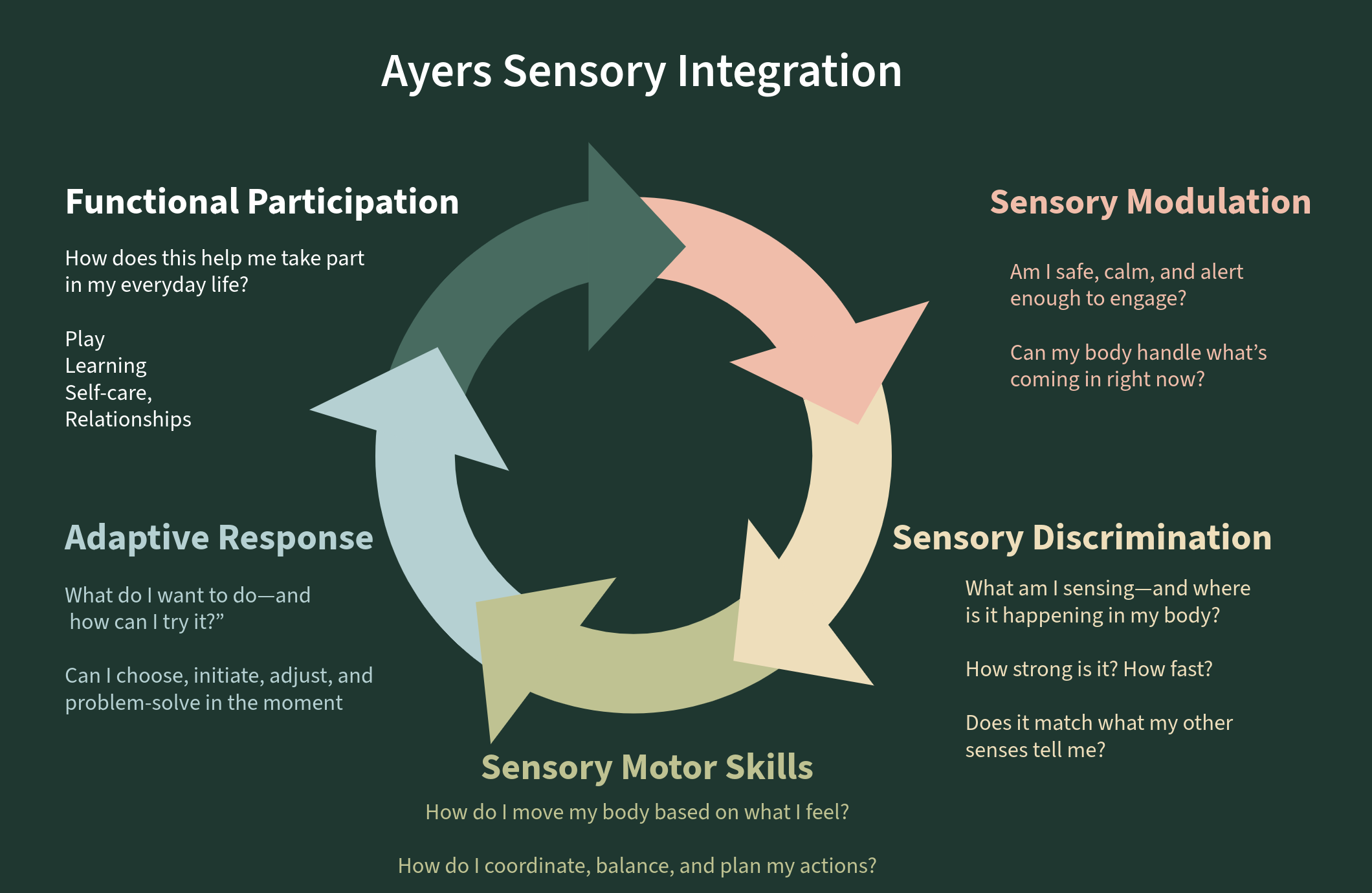
“When your body feels safe, understand sensations, and can move with purpose, you can choose, participate, advocate and grow.”
Neuroplastic Change: Growth
ASI doesn’t just provide a temporary calm—it targets lasting change in the brain.
Through active, meaningful movement and play, the brain creates new pathways for sensory processing, motor planning, and self-regulation.
Over time, children gain the ability to regulate themselves across different situations, not just in therapy.
This means emotional, motor, and cognitive skills grow together, supporting real-life participation and independence.
Occupational therapy with Ayres Sensory Integration helps children feel and function better in the world by:
Connecting brain and body
Supporting regulation that lasts
Improving coordination, attention, and participation
Building the foundation for meaningful daily activities
Families often choose OT and ASI because it addresses the root of sensory challenges, not just the behaviors that show up in the momen
-
Ayes Sensory Integration® (ASI) is a specialized, research-backed occupational therapy intervention designed to help children whose brains have difficulty organizing sensory information.
Science-Based & Internationally Recognized: ASI is grounded in decades of research and used worldwide by occupational therapists. Studies in neuroscience, developmental psychology, and occupational therapy show it supports brain organization, emotional regulation, and motor skills.
Standardized & Measurable administered test- a parent questionnaire . Therapists use validated assessments to identify needs, track progress, and set goals — ensuring therapy is individualized and evidence-informed.
Fidelity to the Model: ASI follows structured, research-based protocols, targeting long-term nervous system change through play, movement, and meaningful activities.
Real-Life Impact: ASI helps children regulate their emotions, coordinate movements, and participate more fully in school, home, and play.
Unlike general sensory programs, ASI is scientifically grounded, measurable, and designed for lasting change, giving families confidence that their child is receiving specialized, effective care. ASI uses sensory motor skills to monitor progress, grow skills, and build confidence, and assess change over time.
-
Ayres Sensory Integration® (ASI) – Occupational Therapy
Provided by occupational therapists with advanced ASI training and certification
Based on a research-backed theory of how the brain organizes sensory information
Uses play, movement, and meaningful activities to help the nervous system organize and respond more effectively
Helps children regulate emotions, coordinate movements, and participate fully in daily life
Supports mental health as it relates to daily function: OTs help children manage stress, regulate emotions, and build coping skills in the context of everyday activities like school, play, and routines
Focuses on long-term improvements in motor planning, sensory processing, and self-regulation
Standardized & measurable: Therapists use validated, norm-referenced assessments to identify needs, track progress, and set individualized goals
Fidelity matters: ASI interventions follow structured, research-based protocols to support long-term nervous system changes
Scope: Occupational therapists may support mental health through functional, activity-based interventions, but do not provide psychotherapy or mental health diagnosis.
Sensory-Informed Counseling – Mental Health Professionals
Provided by licensed mental health professionals, such as counselors or LCSWs
Focuses on emotions, thoughts, coping skills, and mental health support
May use sensory strategies (fidgets, weighted blankets, movement breaks) to help children feel calmer or safer
Primarily supports immediate regulation, not long-term changes in sensory integration or motor planning
Scope: LCSWs and counselors may incorporate sensory strategies as part of mental health care, but this is not sensory integration therapy.
Why Ayres Sensory Integration Matters
ASI is a science-based, internationally recognized OT intervention
Uses standardized, research-backed assessments and manualized, fidelity-based therapy
Supports long-term neuroplastic change in the brain and nervous system, improving emotional regulation, motor planning, and participation
Unlike general sensory programs OT or counseling programs , ASI is measurable, evidence-informed, and individualized
-
In Ayres Sensory Integration (ASI), therapy is child-led, meaning your child chooses how to move, explore, and interact within guided, structured activities. This isn’t just play—it’s scientifically important for brain and motor development.
How It Works: The Neuroscience
Brain and Body Connection: When children lead, their nervous system actively processes sensory information, helping the brain organize sensations and plan movements.
Neuroplastic Change: Child-led activities encourage the brain to build new, flexible neural pathways, supporting long-term regulation, coordination, and attention.
Optimal Motivation and Learning: Research from the OPTIMAL theory of motor learning shows that motivation and choice improve skill acquisition. When children feel in control, their brain learns more efficiently and movements become more precise and automatic.
Benefits of Child-Led Therapy
Encourages self-regulation and emotional control
Supports motor planning, balance, and coordination
Helps children learn skills through meaningful, motivating play
Builds confidence and problem-solving abilities while engaging the whole body and brain
Why This Matters for Your Child
Child-led therapy ensures your child actively participates, not just follows instructions
Every movement and choice is an opportunity for the nervous system to reorganize and strengthen
This approach makes therapy fun, meaningful, and effective, supporting real-life skills at home, school, and play
In short: letting your child lead isn’t just about choice—it’s about optimizing brain and body learning for lasting change.